• About

The Wild Pretanī

  • The Lime/Linden Tree – a “lesser” tree in the eyes of Ancient Britons?

    December 9th, 2025

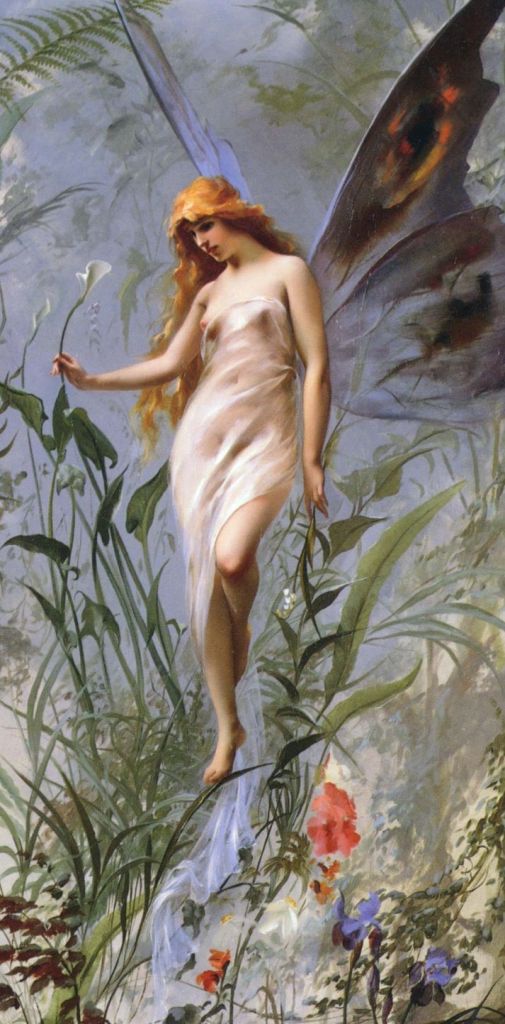
    The linden tree. It stood unchanged since the first time Papa Horatio had seen it, all those years ago— unchanged, Alaine thought, for perhaps centuries. Always green, always blooming, even in the middle of winter. Now, at the cresting of summer, it almost blended into the deep green of the forest, except for the perfect circle of velvet green surrounding it. That, and the scent. Ebbing like a tide on the gentle breeze that stirred the linden’s leaves, the perfume mingled the ordinary golden florals of linden blooms with strange notes of vanilla and cedar and incense.” ~ Rowenna Miller, The Fairy Bargains of Prospect Hill

    The Lime/Linden tree (genus Tilia) has a place among the “sacred” tree types of Europe. You’ll find it referenced in Slavic, Baltic, Germanic, and Greek mythologies… and even into Asia, in northern China. It also remains a national symbol of the Czech Republic, Slovakia, Slovenia, and of the Sorbs in Lusatia. Yet, when it comes to the Brythonic/Brittonic languages, words seem to struggle to find shared meaning and significance. Was that a reflection of lesser appreciation or respect?

    At first, I thought… perhaps… but then, maybe I shouldn’t be so hasty.

    In Welsh, breaking down the compound word, pisgwydden (plural: pisgwydd)… the first part, pisg, isn’t well-documented, and by itself, can mean blisters or pods. Yet, when combined with gwydden (gwŷdd, meaning “trees” or “wood”… by the way, that double “dd” should actually roll off the tongue as a “th” sound), it refers to the Linden tree.

    The Cornish word (pry, prye, or prys), however, does not align (at least in my opinion) so smoothly in sound against the Welsh pisg, and I struggle to see shared origins in a Common Brythonic word.

    That being said, I also saw a reference to the Cornish word Elowen (relating to Elaw/Elow) being associated with the Linden… though it actually means “Elm tree”. In this instance, the similarly sounding Breton word for the Linden is… evlec’h (or *evlec‘).

    So, what’s going on?

    At this point, I found it might be worth “climbing” from Brittonic, further up into the Insular Celtic linguistic tree, and then back down the other side, to Goidelic (Scots Gaelic, Irish Gaelic, etc.).

    In doing so, I found the Gaelic word for linden tree (or lime tree) is crann-teile (Scottish Gaelic) or teile (Irish Gaelic)… both, clearly connecting to the genus name Tilia. The crann (tree) or craobh, means tree… and relates to the Gaelic leamhán (which, I would argue, sounds much like the Cornish elow/elaw).

    I had to wonder if… in elow/elaw and leamhán, was I seeing something significant tied to the Old Germanic word for law (hinting at a possible connection in the Proto-Indo-European linguistic tree). After all, the Linden tree was symbolic for peace and justice (as well as… love, fertility, friendship, healing, protection, endurance, and renewal). Lindens were traditionally seen as a sacred space where no lies could be told. It was the site for assemblies, legal proceedings, and important judgments. Not to mention… the word law comes from the Old English lagu, which was borrowed from the Old Norse lagu, meaning “things laid down or fixed,” derived from lag (“layer, measure”), ultimately from a Proto-Germanic root related to “to lie” or “to lay”. This highlights law as something established or set, unlike Latin-derived terms like lex or legal, which come from roots meaning “to gather” or “to bind,” showing different cultural approaches to defining law (laid down vs. gathered rules).

    Yet, as I kept unraveling, it seemed more likely that I had encountered a homophone… the whole “sounds like..  but isn’t the same”.

    Looking just at the Gaelic leamhán, I found it could mean a number of things… from elm tree, to a moth (particularly a clothes moth), and even to the marshmallow plant… which shares linguistic roots related to softness or weakness. 

    Wait, wait… softness or weakness?

    Without going too far down yet another path, it’s probably worth noting that the Linden tree is soft and easy to carve, making it suitable for instruments, furniture, and sculptures.

    It seems the further I go, the more uncertainties and/or possibilities there are.

    Back to my original question, then…

    Was the Linden tree of lesser importance to Britons? More specifically, I wonder if it was less significant to Britons, say… prior to the arrival (ca. 410 AD/CE) of the Anglo-Saxons, who… perhaps… brought with them the significance of Germanic symbolism of the Linden?

    I can’t find a definitive answer, and given the timeline and scant history, it really shouldn’t surprise me.

    Coming down the historical timeline, the Linden seems to have held some significance in Britain. J.R.R. Tolkien’s Lord of the Rings certainly left us tastes of its enchantment in both Aragon’s Song of Lúthien…

    He heard there often the flying sound/Of feet as light as linden-leaves.

    … and Legolas Song of Nimrodel…

    And in the wind she went a light/As leaf of linden tree.

    … both, seemingly, influenced by Geoffrey Chaucer’s (ca. 1343-1400) Canterbury Tales…

    Be ay of chiere as light as leef on lynde,
    And lat hym care, and wepe, and wrynge, and waille!”*

    I’m curious, though. Even with the boost from Tolkien, how did the Linden get left out in the contemporary sacred Pagan trees of the Wheel of the Year?

    So ends today’s journey in the Brittonic…

    *Be ever of cheer as light as a leaf on a linden tree,
    And let him (your husband) care, and weep, and wring his hands, and wail!”)
  • “You’re not a Viking”- a problem with too quickly belittling identity in ancestral DNA

    December 5th, 2025

    On one hand, I get it… in fact, just this past summer, while in Norway, I had an interesting exchange with a Norwegian about DNA and an American’s (for example) claims of “being” German, Dane, Irish, Scots, or whatever. I agreed that an American should not claim that they “ARE” any one of these if they did not grow out of the respective, contemporary cultures. But, to say they “have origins in” a country… that should/might(?) be understood as identifying oneself to some sort of quest… an attempt to understand… something… in their DNA results.

    Taking this back to the title of this post… the same might be said of the whole “Viking thing”… though, I think this gets complicated. About twenty years ago, I told someone about my “Viking origins”. They asked (fair question) how the DNA proved such a thing, and I responded that it was because one DNA company (over the years, I’ve tested with five, total) showed I was over (at that time) forty percent Scandinavian. They responded that just because it showed Scandinavian origins doesn’t mean that it was Viking in origin. That’s absolutely true, but… for having done genealogy for over thirty years (at that time), and having reached back in most lines to the 17th century (some even further… supported by primary source materials,  of course), I had encountered not one instance of a Scandinavian surname. However, the Viking thumbprint on DNA in the British Isles, France, Germany, the Baltic, etc. (all areas indicated in my DNA origins), cannot be easily dismissed.  Further, in the time since that discussion, I’ve significantly expanded my work in Y DNA studies and have seen Pretanī Y in Norway, Denmark, Sweden, and Iceland… and Scandinavian Y in the British Isles. It’s a throwback to massaging the brain for the old lessons of World History 101, but through another type of magnifying glass.

    It hasn’t been measured, so I can’t show percentages, but, I think most who take DNA tests (and, by the way, per an M.I.T. study, as of 2019, an estimated 26 million had tested their DNA for ancestry… and, by the way, one in five Americans have tested their DNA.) are just trying to get a handle on their ancestral origins… maybe even trying to see if it aligns with what they already “know”. Some even test to finally “prove” Native American origins (and, in my experience, frequently fail). Anyway, I think a good many get their results, say, “cool” and then tuck them away as some sort of “mission accomplished”.

    I could go on and on about this (and, I’m likely to expand on some things in future posts), but I want to move along to thoughts on an even deeper motivation.

    Could this journey through DNA reflect a need to identify to a sort of lack of “tribal” connection… a personal, genetic cry for something(s) absent in ourselves and in the world, today? Walking this back to the “You’re not a Viking”… I wonder… would it be right to belittle a person, so many generations removed from their Native American roots, for trying to reconnect with the same? Why then should anyone be quick to dismiss someone else’s “journey to reconnect” with their own indigenous (indeed, Animistic) spirituality… be that Nordic, Brittonic, or otherwise… or even a blended rebirth of a combination, in a new understanding, found comforting to navigate the modern world?

    *Photo (hazy as it is) of a very enjoyable dining experience I had in the Viking camp at Midgardsblot, in Borre, Norway, this past August.

  • A thought before that seasonal kiss under the…

    December 4th, 2025

    We might do well to embrace Brythonic words for a popular toxic, parasitic evergreen plant used for Winter holiday decorations and for its peer-pressuring one into a kiss. Whether Welsh, Cornish, or Breton (uchelwydd/ughelvarr/uhelvarr), the meaning is quite simple. Broken down,  “uchel“ = high, and “gwŷdd“ = trees. That said, I think (because it just sounds cool) I like a much older word, going back to Old Welsh and Old Breton… hisæl-barr.  While”hisæl,” is not clearly defined (but, I think it sounds a lot like “mistle”, and the backstory of the æ might be further-telling), “barr” is derived from the Gaelic and Brittonic words for “height” or “hill” and is used here to mean branch or thicket. More or less, the Brythonic (uchelwydd/ughelvarr/uhelvarr) focuses on the fact that accessing the plant usually requires scaling a tree in some way.

    On the other hand, from Germanic linguistics we find the word “mistletoe“… from the older form ‘mistle’ adding the Old English word tān. ‘Mistle’ is from Common Germanic (cf. Old High German mistil, Middle High German mistel, Old English mistel, Old Norse mistil).

    Ultimately, the Brythonic pretty much explains what was necessary to get to the plant, while the Germanic focused on what appears necessary for how the plant is seeded.

    So, to my point… would you rather have the Brythonic uchelwydd/ughelvarr/uhelvarr floating over your head as inspiration for a seasonal kiss, or… “mistel” (meaning “dung”) and tan (meaning “twig”), combined to form misteltan/mistletoe?

    That’s right… the plant’s seeds are spread by birds wiping their bills on branches or by their droppings, making it a “dung-twig”. The final “-toe” was a natural evolution from the Old English word for twig.  

    Oh, and by the way did you know the tradition of kissing under the mistletoe is rooted in 18th century (or more narrowly, 1720-1784) England?

    The “mistletoe song” from 1784 is a song from the English comic opera “Two to One” by George Colman the Younger.

    What all the men, Jem, John, and Joe / Cry, ‘What good-luck has sent ye?’ / And kiss beneath the mistletoe / The girl not turned of twenty

    Enjoy your seasonal tradition… 😉

  • When symbolism becomes part of daily living

    November 25th, 2025

    Imagine a black cat walking atop your fence.

    What does it mean?

    But wait, the title of this post might be misinterpreted. A post probably shouldn’t start with me noting this. Yet, it could be misinterpreted, and maybe that’s ok. If I wanted to keep all of this to myself, I wouldn’t be writing this post. So, let’s move on and just go with the flow…

    This is MY interpretation of… interpreting… and it may or may not be that of any number of people… and that’s fine. Maybe, then, this is about embracing individual interpretation of meaning, yet accepting that someone else can see it differently… and that your interpretation works for you, while that of someone else works for them… and neither needs (hopefully) to step across that indivisible boundary that says that someone is right and someone is wrong. Maybe, sometimes, there is mutual interpretation of something. How wonderful, no?!

    Now that this is out of the way… I think…

    I’ve long been fascinated by symbolism in different things, especially how one symbol can be interpreted different ways to different people, both over time and at the same time. But let’s move beyond interpreting, say, a physical symbol interpreted for its cultural significance or offensiveness. What happens when we open the door to individuation of the spiritual?

    I don’t think I can possibly go further on this without noting that one shouldn’t force it (or, maybe that works for some?). Just because someone sees something, is it good practice to immediately try to see if it fits in a square, circular, or whatever-shaped hole? Let’s say someone sees an Eagle flying overhead. Should they immediately take significance in it, or will it come to them as a metaphor for something a few days later? The right answer is/could be… yes.

    Personally, and for whatever reason, in recent years, I’ve come to appreciate being patient. I try not to force meaning in the moment. So, getting back to that black cat…

    For one, it happened a few days ago. I know her. She’s one of a couple of feral cats around my house. When I saw her walk the fence, I was amazed given 1) how fragile the fence has become in the nearly six years since I weaved it and that it didn’t snap under her, and 2) the grace with which she walked across it. I also embrace the color black, so the whole “fear of black cats” thing just doesn’t exist for me. Anyway, it happened, and, at that moment I just thought it was pretty cool.

    Turn the page forward to “mind stirrings” this morning…

    I often think of how to best work as a patient interpreter of spiritual meaning in symbols/happenings. Frankly, I like the image of gently projecting weightless energy in a form of a pleasant, smoke-like mist, and then how it can commingle with the energy of something else. Ultimately, in the mind’s eye, it becomes a beautiful, swirling dance of energies… two or more mists intermingling, working together for a mutually appreciated, yet-to-be-made-clear, purpose (is this part of “living in the moment?). It’s not directed as some sort of forced “manifestation”. It’s merely an encounter… me wanting the opportunity to work as a partner with, say, some form(s) of nature. Perhaps something comes of it, perhaps not. Yet, I find not (impatiently) expecting a result can lead to one, and that it is rather pleasing to the soul. I celebrate the chance to encounter other energy more than the result… but appreciate both.

    I know, I know… I seem to be getting further and further from the black cat on the fence. Allow me to weave a bit more, in order to fully assemble the picture.

    There’s a philosophy in modern druidry, and indeed, witchcraft…

    Ugh… alright, push away any stereotypes this invokes. Clean them away, and just listen without listening to respond with something negative. I hate that I even have to brace for such a thing. Moving on…

    There’s a philosophy about “hedge-riding”… and, by the way, “hedge druids” and “hedge witches”? Generally defined, solitary practitioners of a form of folk magic that focus on the liminal spaces between the physical and spiritual worlds. So, “hedge-riding” might be defined as entering an altered state of consciousness to travel to the Otherworld or… even the natural world… for guidance and messages. It can be a form of trance work… which, frankly, conjures up more stereotypes and misunderstandings. To me, it can mean conscious, semi-conscious, and even unconscious. Since I’ve gone down enough rabbit holes in this post, and get further and further from my point… I’ll leave this without further explanation at this time…

    That black cat on the fence was appreciated at the moment I saw it, for what I already explained. My thoughts this morning (which I already noted as well), bounced around the ideas on “hedge-riding”, or how one can work in the liminal spaces, between the physical and spiritual worlds. In that the black cat walked on this fence, it reminded me, also, of my work within and outside the spaces around the fence. Inside the fence is my soul space… my garden… where, for hours, I can quite literally, lose myself in the time I spend tending my herbs and plants. On the outside, within about ten yards… my driveway. Symbolic of two different worlds, and a metaphor, to boot.

    “Magic”, or a series of coincidences that only I’ve spun together in my imagination? Well, for one, I take my “coincidences” in Jungian form, so… not coincidences. As far as “magic” goes… I’d argue that folklore and Hollywood have built many a misunderstanding in our heads as to what magic truly is. Symbolism? Yes, for me, and it’s enough for me.

    How can we both embrace and let go? How can we commingle with other things, and, indeed, people… enjoy the differences in the moment… and just walk away in celebration of the encounter? As for the spirituality in symbolism… the inferred “magic”, perhaps… maybe it’s only realized later. Maybe it’s not just a read on something we observe, but also what we realize about ourselves in the aftermath. Perhaps it also results in seeking a change in ourselves… and perhaps I’m going down yet another rabbit hole. 😉

    *Yes, that’s an image of the wattle fence I made nearly six years ago.

  • Discovering “cynefin”

    November 13th, 2025

    Curious as I am in discovering Brythonic/Brittonic words and/or phrases, this morning I set off looking for something comparable to what Carl Jung considered “synchronicity”.

    If you’re unfamiliar… while Jung believed in coincidence, he coined the term synchronicity for what he considered “meaningful coincidences” that cannot be explained by cause and effect. He theorized that these events connect inner psychological states with outer, unrelated events and are not random, but rather a manifestation of a deeper order in the universe. 

    I found translations… “Cydamseriad “, meaning “synchronization” or “simultaneity”… and Cyd-ddigwyddiad, which is the Welsh word for “coincidence”. Both are simply translations, but neither embraces the depth of Jung’s idea of synchronicity. Maybe I’ll look more.

    Still, the search was not without fruit… it just wasn’t the fruit I was looking for. I came across two words that AI seemed to find worthy in my search for Jungian synchronicity… “hiraeth” and “cynefin”.

    “Hiraeth” is Welsh word (equivalents in Cornish and Breton being “hireth” and “hiraezh”) that seems to make its rounds in memes… though, the word is interpreted slightly differently (nuanced?) from its actual meaning…

    …a homesickness for a home to which one cannot return, a home which maybe never was…”

    …as opposed to…

    …homesickness tinged with grief and sadness, a mixture of longing, yearning, nostalgia, wistfulness.

    While I love even a nuanced consideration of “hiraeth”, I was far more interested in the lesser known/lesser meme’d “cynefin”.

    “Cynefin” is a Welsh word (in Middle Welsh, it was “kynevinaw” and in Old Welsh, “cenedi”), though given the Cornish word is “cynevin”, Brythonic origins appear clear. I just can’t find the Breton equivalent… yet. There is no equivalent word in English, or in any Germanic tongue. Indeed, I couldn’t even find a Proto-Indo-European (PIE) equivalent. So, I’m rather pleased that it seems rather exclusive among the tongues of Europe.

    The meaning?

    Historically… supposedly… it was used by farmers to describe habitual tracks left by animals on hillsides. If that is truly the case, the meaning seems to have gained deeper meaning over time. Consider this…

    A place of existential belonging*; a synchronicity between people and their relationship to their habitat and cultural history.

    I also found…

    Beyond a physical or geographical place, historic, cultural & social dimensions.

    Though there is no English equivalent (nor one rooted in Germanic or PIE), the Māori have something similar… “tūrangawaewae”… meaning, “place to stand, or ground and place which is your heritage and that you come from”.

    Now, I think the concept of “cynefin” has flexibility. It can wrap itself around us, individually, to what we feel we fit within. Perhaps it’s a matter of where one grew up, along with the heritage of place and people. Perhaps it’s something more complex… that “existential belonging*”. Perhaps it can be both… and even more.

    For me, personally, I see “cynefin” as a personal connector in two ways, and the profoundly deep one is having realized a sort of vibrating tribal energy that exists in a unique Brittonic word that taps into my genetics.

    Maybe, in a way, I did find what I was looking for, after all.

    *existential belonging – deep, innate sense of connection to the world and the fundamental nature of existence itself, beyond just social connections.

    Image: the summit of Snowdon, the highest mountain in Wales. Source: Wikipedia

  • Yes, but have you ever smelled Sweetgrass?

    October 15th, 2025

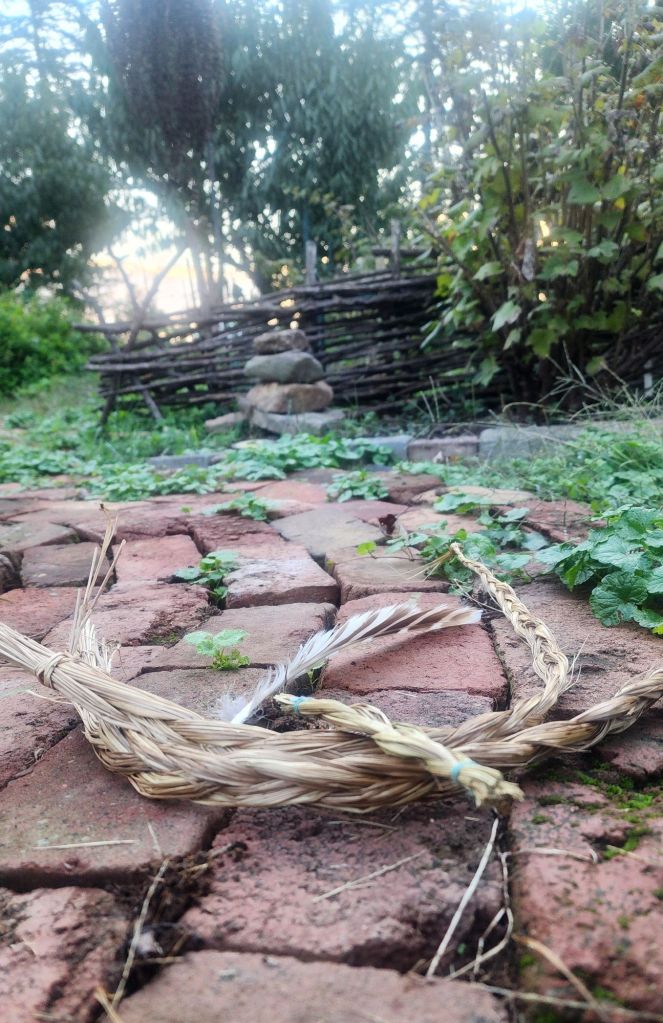
    It’s been a few years since I ordered my copy, but after reading quotes and reviews, around 2021, I purchased Robin Wall Kimmerer’s Braiding Sweetgrass. As I read it, I wondered… what does Sweetgrass smell like? My curiosity raised, I looked to Etsy to order a braid of Sweetgrass (actually, I ended up ordering a few). Excited when the package arrived, I hastily ripped open the top, reached inside, grabbed a braid, and raising it to my nose, exclaiming in my mind, “I’ve known you all along!”

    It was a familiar scent that I connected to specific places, even back to my childhood. Now, I imagine individual associations likely vary, but with me, I often caught a whiff of it when near certain historic sites in the eastern US… most especially those where battles of the American Civil War and Revolutionary War were fought (and even Colonial Williamsburg). It’s not like the scent floats over the entire battlefield or site, but I tend to pick up the fragrance in nearing or passing said places. After a while, I just joked about it as if it were my own personal radar to those historic sites, but, when I traveled to Europe (specifically, on a trip in 2022), I caught a hint of it in Scotland, when approaching a family castle, and later, in 2023, when near a broch near the Isle of Skye.

    Surprised I found it outside the US, I had to look up the distribution of the grass… the botanical name being… Hierochloe odorata or Anthoxanthum nitens (though it is not the same as Anthoxanthum odoratum… Sweet Vernal Grass… which smells more like freshly mowed hay). In addition to being referred to as Sweetgrass/Sweet Grass, it is also known as Manna grass, Mary’s grass, or vanilla grass. Further, not only is it found in North America, but also the UK… where some refer to it as “holy grass”. So, smelling it in Scotland (and most recently, during my trip to Germany) is not unusual. Apparently, even Poland uses it (calling it bison grass) in some vodka (such as Żubrówka and Wisent)… and in Belgian-style beer. But, I digress…

    It’s not my intent to write a paper on the subject, but I’m more interested in its spiritual connection. Among Indigenous peoples in both the US and Canada, it’s considered sacred and is used as a smudge in herbal medicine. Robin Wall Kimmerer notes:

    When we braid sweetgrass, we are braiding the hair of Mother Earth, showing her our loving attention, our care for her beauty and well-being, in gratitude for all she has given us.

    So, to me, the fragrance has a meaning that has grown in significance. It’s no longer just that radar pointing to personal connections to historic sites. But, putting aside my personal connection and love of its fragrance, if you’ve read Kimmerer’s book, have you also taken the time to discover the fragrance? Perhaps you’ve got your own personal connection.

  • That dark, foreboding cabin in the wood…

    October 10th, 2025

    Earlier this week, I decided to walk away from the Facebook profile I had maintained for over seventeen years, for another profile I created about two years ago (under a newer nom de plume than one that had been with me for as long). When I created the new profile, I did so with the intent of weaving it together with posts more central to content I intended for a new blog (this one), and a community with which I found myself growing more comfortable. I “inhabited” the new profile for a little while, left it, and have now returned. I simply felt the “ghosts of yesterday” did not mesh well with a transition that’s been ongoing (in retrospect) with me for at least the last six years. In that old profile were my old interests, my old blogs (and, often, theme-related posts), and, indeed, many of my (remaining) friends… some being relatives, some actual friends, and yet, others who were online acquaintances with whom a sort of mutual, virtual “friendship” had developed.

    It made me wonder. Did I abandon my… MY… own personal space because of…maybe… what I felt were expectations of the old following, or did I leave because where I once was is no longer where I am today? Perhaps both. Further, given the current divisions in political beliefs, maybe even more than that. I felt a need to break away.

    It dawned on me a few days later that, in that transition, my actions may have actually mirrored a meme. You know… the one that occasionally pops up, that shows a dark, foreboding cabin in the woods, usually accompanied by wording that explains a desire to retreat forever to said cabin. Yet, I didn’t abandon everybody. For those who had actually followed my posts for the past two to three years… followed my annual travels to Europe and the shift in the very nature of my posts… I extended a hope, that perhaps I’d see them… here.

    A few did follow, and to them, I hope that my new “cabin in the woods” isn’t as foreboding as it may be to others. It’s funny, but it brings a memory to mind… of my visit to the Grasmere Gingerbread Shop, in the English Lakes District of Cumbria. If ever there was a place from which I could virtually share the enchantment of the olfactory, it would be the smell and charm of the little store that sells Sarah Nelson’s gingerbread. It’s that sort of warmth and comfort that I hope I can convey in at least some of my posts.

    Now I know that there might be some irony in talking about a dark, foreboding cabin in the woods… and the smell of gingerbread. Lol. Maybe it’s welcoming to some while being foreboding to others because of the difference in being open-minded when it comes to the content of this blog and my new FB profile. Perhaps, then, the duality in the meaning of the imagery is purposeful and appropriate.

  • The Fae (a little discovery)

    October 7th, 2025

    In looking for a Brythonic word of the day (something I’m going to try on a regular basis) yesterday, I ran across something I didn’t realize. But, first… in general, fairies have a negative place in the history of Christianity. They have often been considered demoted angels, or even demons. In fact, in Daemonologie (1597), King James I (yes, the same name behind the King James Bible) indicated “faries” were (per Wikipedia) “illusory spirits (demonic entities) that prophesied to, consorted with, and transported the individuals they served; in medieval times, a witch or sorcerer who had a pact with a familiar spirit might receive these services.”

    Even so, there have been instances throughout history whereby faeries haven’t had such a bad rap among Christians. As early as 248 AD, in Contra Celsum, early Christian scholar Origen of Alexandria (c. 185 – c. 253) noted:

    We indeed also maintain with regard not only to the fruits of the earth, but to every flowing stream and every breath of air that the ground brings forth those things which are said to grow up naturally — that the water springs in fountains, and refreshes the earth with running streams — that the air is kept pure, and supports the life of those who breathe it, only in consequence of the agency and control of certain beings whom we may call invisible husbandmen and guardians; but we deny that those invisible agents are demons.

    Furthermore, even contemporary Christian theologians John Milbank and David Bentley Hart have spoken and written about the real existence of fairies. Give a look over at the sub-category “Christian belief in fairies” in the entry for “Fairy” in Wikipedia.

    It’s not my intent to fill this blog with content heavy-laden with Wikipedia, but when it comes to an entry being too large for a Facebook post, I may do a micro-post, like this one. Further, after about ten months of silence in this blog, I’m going to give it another try. I initially struggled with where I wanted posts to go, but I think I’ve finally figured it out. Hope you follow along and enjoy!

  • Glæd Mōdraniht!

    December 20th, 2024

    One of the many different things I’ve thoroughly enjoyed in my travels in Europe is, often after visiting certain sites, developing a better understanding of the different practices of the ancients in relation to the same.  In some instances, it might be more about mulling over the morsels left behind by certain people.

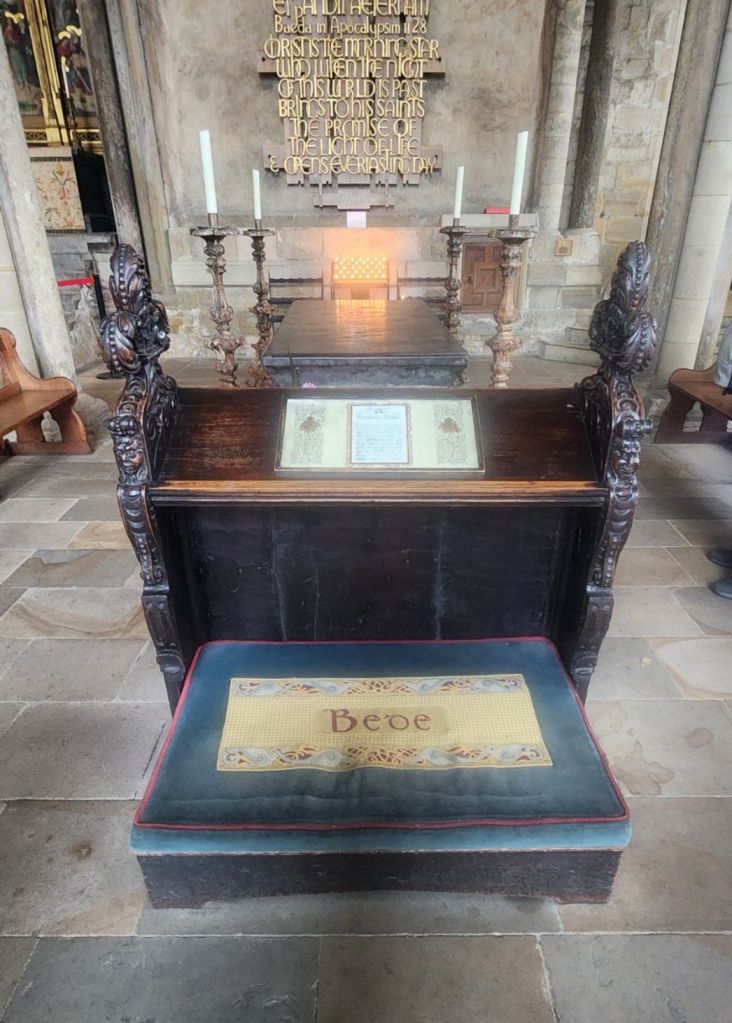
    My “pilgrimage” to the crypt of Bede, just last year, was really to stand before it, in curiosity and awe of the time in which the man lived… on the cusp of faiths in history, as pre-Christian practices were slowly (or violently… it all depends on the people/event/place) brushed aside for Christian practices.

    Despite his being a Christian monk, his work as a historian left fragments of the unclear/unknown side of that cusp. But, at least he left something. Even while working to spread Christianity, he made notes of old practices. While they were often quite vague, etymology and mythology gave us just enough to blend together and consider. Take, for example, Mōdraniht. In De temporum ratione, Bede wrote (and, yes, I’m looking to Wikipedia for part of this):

    Incipiebant autem annum ab octavo Calendarum Januariarum die, ubi nunc natale Domini celebramus. Et ipsam noctem nunc nobis sacrosanctam, tunc gentili vocabulo Modranicht, id est, matrum noctem appellabant: ob causam et suspicamur ceremoniarum, quas in ea pervigiles agebant

    Roughly interpreted:

    …began the year on the 8th calends of January [25 December], when we celebrate the birth of the Lord. That very night, which we hold so sacred, they used to call by the heathen word Modranecht, that is, “mother’s night”, because (we suspect) of the ceremonies they enacted all that night.

    If curious, I encourage reading more about theories in the link to Mōdraniht in Wikipedia. There are also other resources online, but as a historian, I tend to prefer the sustainable… things that, for example, could hold up in an academic argument.

    In the spirit of one of my favorite quotes from Einar Selvik:

    I do strongly recommend people to take the travel and start reading books with a little bit of academic starting point, because it’s so easy to climb into trees that don’t have roots.

    Theories range from Mōdraniht being tied to a West Germanic sacrificial festival of a Matron’s cult, to the dísir and the norns. So, either way, Germanic at its base, and who’s to say if there wasn’t some bleed over, one way or the other, with similar versions among Celts, Romans, etc.

    Ultimately, it’s impossible to do anything with Mōdraniht and claim absolute authenticity. Instead, I think the spirit of the night… the central focus being on the mother ancestors and/or honoring the female spirits or deities… is what matters. To each their own, but looking at the names of women in my family tree… and thinking about the women who are nameless to me, well outside recordable history… that’s moving energy in the right direction.

  • A gift… and obligation.

    November 8th, 2024

    Within the past month, I thought that I’d like to find an owl feather. Now, one can, no doubt, purchase one on Etsy, but where’s the magic in that? No. I concluded… the feather only comes if deserved. 

    Strange to say, but the thought of finding the single feather took me back, nearly forty years, to a time when I found an entire owl… but even stranger was that, tight in its talons, the owl STILL grasped a rabbit. Both were dead, with no visible evidence of “death by human.” In the violence of the interaction, did they end up killing each other, concussed by the flailing? Another question that comes to mind… was there symbolism in it that I totally missed? I mean, it’s quite peculiar, and what are the odds?

    Anyway, so the stage was set… I wanted to find an owl feather. Yet, I fully embraced the idea that IT WOULD FIND ME when the time was appropriate.

    So, driving out from work just yesterday, on an errand during lunch, I noticed a large bird… death by another automobile, no doubt. Was it a hawk… perhaps an owl? I was determined to investigate on the way back from my errand, but found myself increasingly bothered that I didn’t actually stop then and there. Errand completed, I returned to the spot, pulled over, and looked. It was a Barred Owl (common to Eastern North America). I was saddened for the loss of life, but immediately thought that in its passing, was this a gift? This quickly moved from my mind, and I focused on respect. I removed her/him from the road and gently laid the remains in the tall grass, away from yet further disrespect.

    My thoughts returned again to the idea that it might be connected to my hope of finding a single feather. Without going into gory details of the poor creature’s fate, I asked her/him permission, not to take a gift for myself, but to honor the messenger and the message. Yet, in retrospect, at that time, I don’t think I fully understood what the message was. It was slowly coming to me…

    Now, as for “gift”… it wasn’t one that you simply get excited over and walk away with, fully rewarded for the object itself. This was not materialistic. This “gift” had multiple facets defined by obligations… responsibilities. As I pulled away in my car, I think it pulled hardest on my heart, taking part of her/him away from the whole. Once again, I thought to myself that this feeling in me was a reminder… to only do this if the intent is to honor and respect. Don’t be lazily wasteful and disrespectful. If you take, be dutiful, and tend to its care and meaning.

    It didn’t take long to also realize that the day was the 7th of November… by cross quarter calculations… truer to Samhain, this year, than 31 October. So, the owl… the messenger, the day, the message, the symbolism in the entire collective... well, if you know, you know (… and, if you don’t know, find your way on the path). The hits just keep on coming.

    I’ll most certainly be mindful…

1 2 3
Next Page→

Blog at WordPress.com.


Loading Comments...
 

    • Subscribe Subscribed
      • The Wild Pretanī
      • Already have a WordPress.com account? Log in now.
      • The Wild Pretanī
      • Subscribe Subscribed
      • Sign up
      • Log in
      • Report this content
      • View site in Reader
      • Manage subscriptions
      • Collapse this bar